
Searching for a Warrant in Lake County
The main public online starting point for a Lake County court case is the county instance of the Tennessee Public Court Records System, TnCIS. It lets a user search participating Circuit Court and General Sessions files. It does not search every sheriff, municipal court, juvenile file, or federal docket, and it does not certify an active warrant. A search result is a case lead. The clerk who holds the file can explain what document or court event appears there.
Use the full name and any case year or number already known. The form does not show a date-of-birth field in the reviewed version. For a city citation, contact the city court. For a service question, ask the Sheriff’s Department. If a result may concern you or a family member, confirm it with the issuing office and seek legal advice before arranging an appearance.
- Open the Lake County TnCIS search and select the court office that may hold the case.
- Enter a party name, then narrow the search with a year, case number, court type, or case type if known.
- For Tiptonville or Ridgely ordinance and traffic matters, ask the municipal clerk about its separate record.
- Call the issuing court clerk about a match or a missing result; ask the Sheriff’s Department about service procedure.
- Use a separate federal court route for federal matters, and confirm any personal case with counsel and the issuing court.
Lake County’s TnCIS Portal Is a Case Search
Use the county-specific Lake TnCIS search form for participating trial-court records. Its court selector offers Circuit Court and General Sessions; its case choices include criminal and civil. The page requires a Turnstile check before Find Now. The system is useful for locating a court file, but its scope is the participating office and record set, not every warrant held by every Lake County agency.
The official form is the best way to see its current layout. 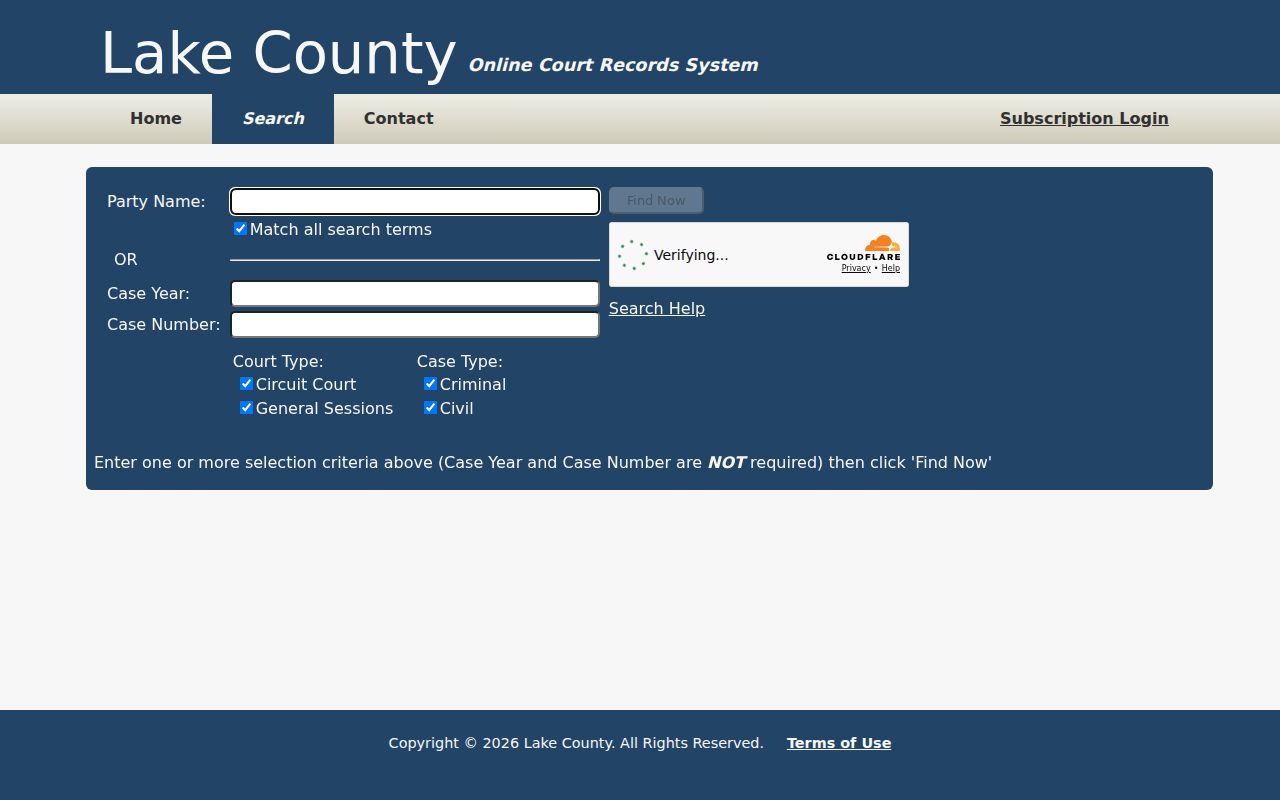 The image documents the search interface, not a warrant result or a public roster.
The portal landing page is another route into case records. 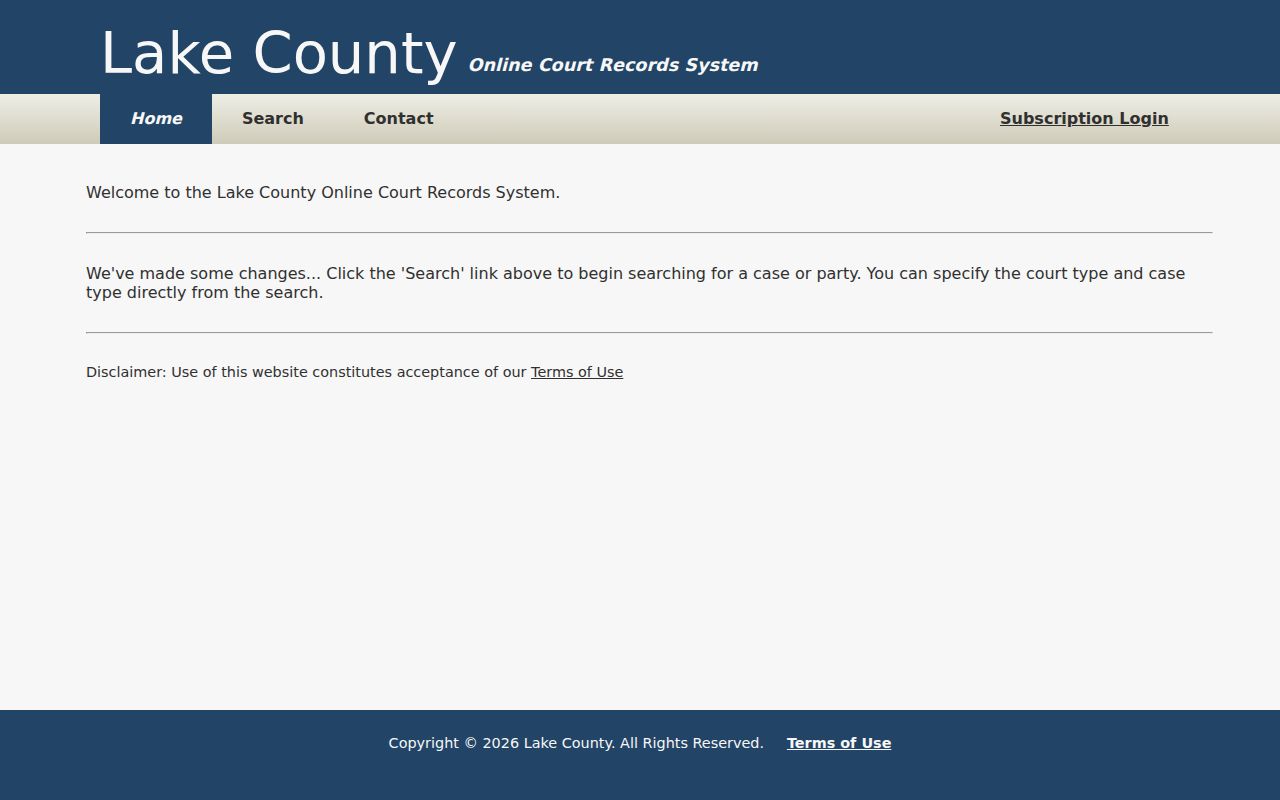 It does not offer a separate warrant registry.
Warrant Search Fields Explained
The Lake County form asks for a party name and permits additional case criteria. It does not ask for a birth-date field in the observed layout, so do not treat a same-name result as a confirmed identity. The match-all option, case year, case number, court type, and case type let the user narrow the query. Search help recommends full names and documents limits on field lengths and result volume.
| Field Label | Type | Required | Notes |
|---|---|---|---|
| Party Name | Text, up to 100 characters | No | Full name is recommended; name similarity is not identity confirmation. |
| Match all search terms | Option | No | Can narrow a multiword party-name query. |
| Case Year | Text, up to four characters | No | Use when the filing year is known. |
| Case Number | Text, up to 50 characters | No | Enter the number from court papers if available. |
| Court Type / Case Type | Selection fields | No | Circuit or General Sessions; criminal or civil filters. |
Lake County Name Searches Have Limits
TnCIS help describes a ten-word query limit, term normalization, quoted phrases, typo tolerance, and a literal filter for columns already visible in the results. Results can be sorted, but the query may return no rows when the name is entered differently or a record is held outside the participating court index. A broad search may reach the portal’s 2,500-row ceiling; add an exact case year, case number, or office when possible.
Those search tools help find records, not decide whether two people are the same or whether a warrant is active. Call the clerk when a common name, spelling change, or old case reference makes the result uncertain.
What a Warrant Search Shows
The Lake County search form was reviewed, but a live sample result grid was not captured. Result-column labels, warrant-status fields, bond fields, export behavior, and any pagination beyond the documented row limit were not observed. Do not assume that a TnCIS match displays an active warrant or that no match means none exists. Ask the clerk to identify the actual docket entry.
| Case reference | Use the case number supplied by TnCIS or printed on the court paper. |
|---|---|
| Party name | Confirm the match with the issuing office; the search field is not identity proof. |
| Court office | Check whether the file is Circuit Court or General Sessions. |
| Process type | Ask whether the docket entry is a warrant, summons, capias, or another filing. |
| Active status / bond | Not observed as a public result field; confirm directly with the clerk. |
Lake County Search Results Have a 2,500-Row Cap
The TnCIS case list caps a returned set at 2,500 rows and offers sortable results. Broad searches can therefore be hard to interpret even when a name appears: narrow the query with a case year, court type, case type, or case number instead of assuming the displayed list covers every possible record. The interface's Party Name field accepts up to 100 characters, and the Case Number field accepts up to 50.
A filtered case result remains a case record. The reviewed grid did not expose a dedicated warrant-status or bond field, so use the court named in the entry to confirm the underlying process.
Lake County Search Results Need Clerk Confirmation
Status field: not observed is the safe reading of the Lake County public search. A result can point to a case, but the research did not establish that it reports whether a warrant is active, served, or recalled. Use the case number and office to ask the clerk what the record means today. A portal row is not a substitute for a current court confirmation.
The sheriff’s page supplies contact details but no active-warrant search, list, or separate warrant phone line. It can route a service question, while the issuing clerk remains the source for the docket’s present status.
Where to Check Warrants in Lake County
For county trial-court cases, start with TnCIS and the Circuit or General Sessions clerk. For service procedure, contact the Lake County Sheriff’s Department at 109 South Court Street, Tiptonville, or call (731) 253-7791. The Circuit Court Clerk’s office is at 229 Church Street, Box 11, Tiptonville; its number is (731) 253-7137. This is the court-clerk route for Circuit criminal files and General Sessions criminal routing.
Tiptonville City Hall handles its city-court route at (731) 253-9922; Ridgely Town Hall is (731) 264-5182. Tennessee has no statewide public self-service warrant search identified in the reviewed official sources. Federal records require a separate federal court route.
TnCIS offers a clerk-office selector and contact route. 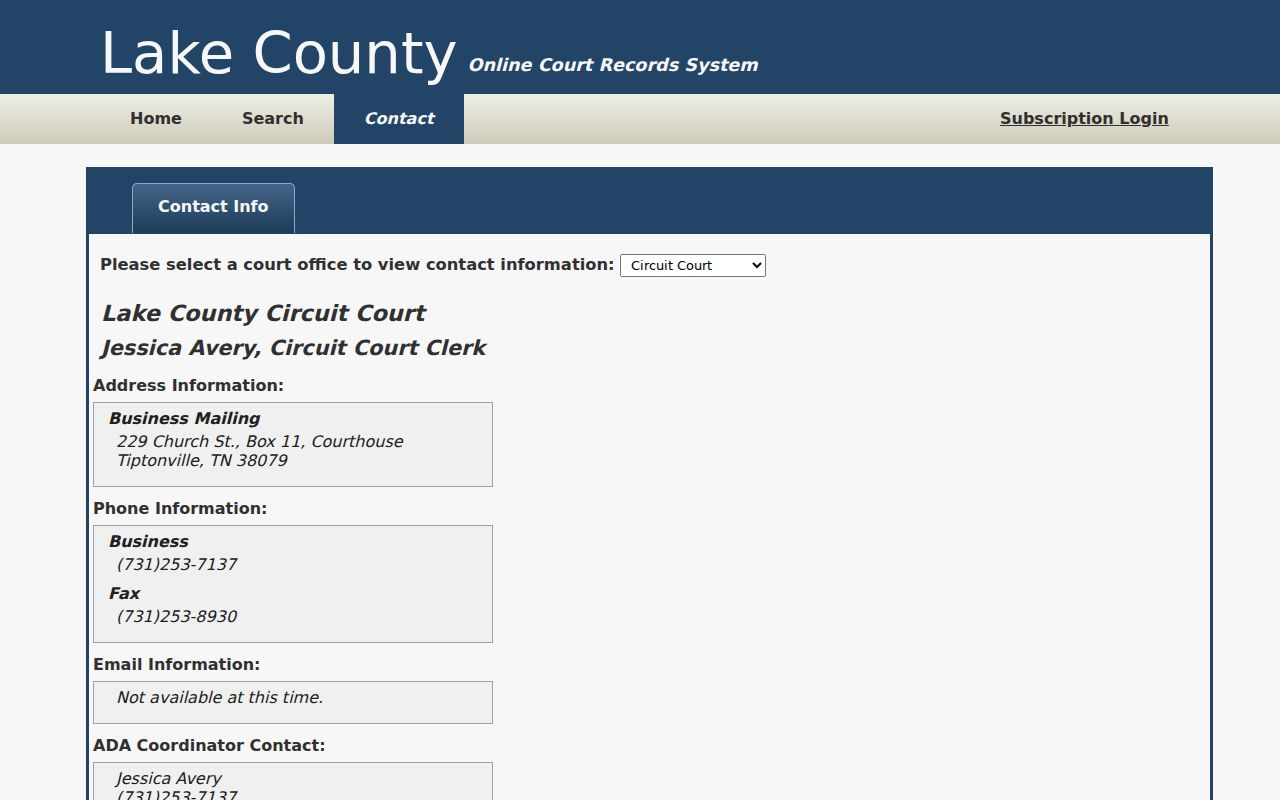 Confirm the office there; this contact screen does not report warrant status.
The county administrative clerk has a separate role from criminal court clerks. 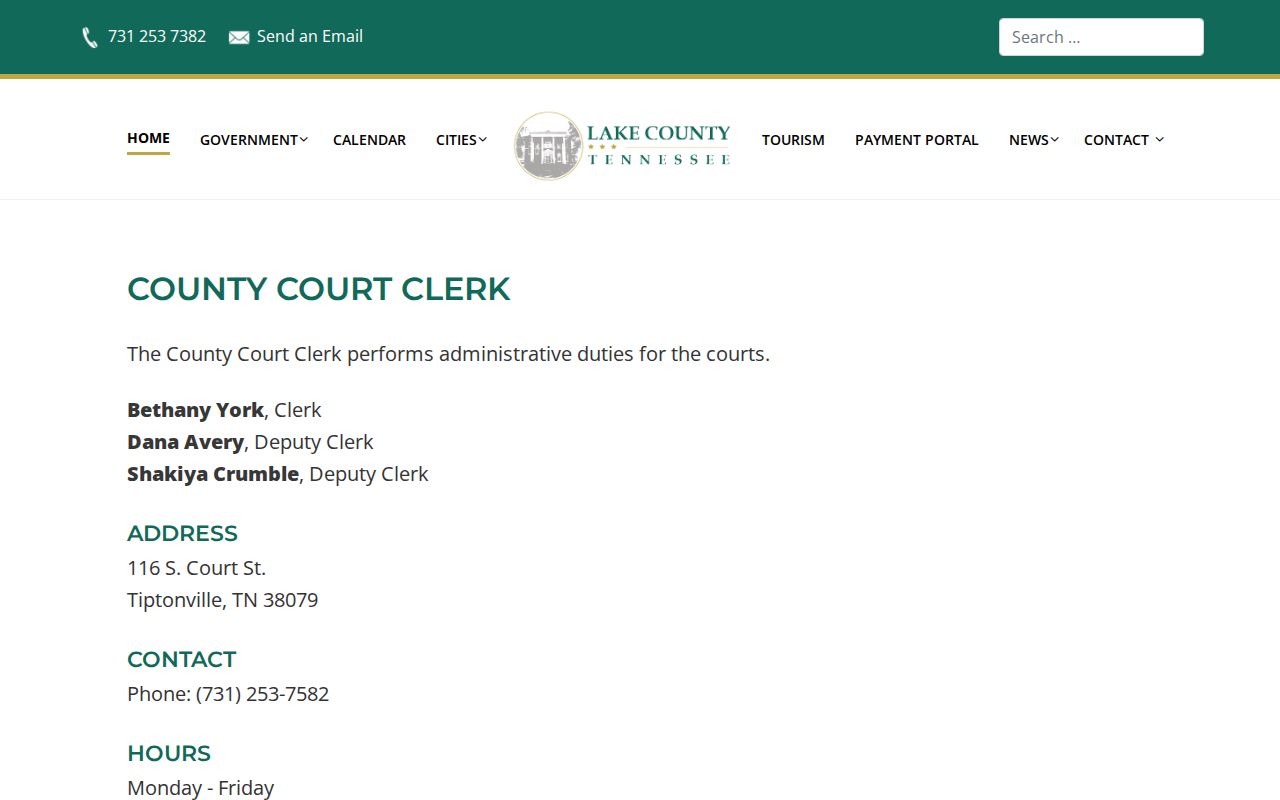 Name the criminal court and case when asking for a warrant record.
Lake County Municipal and Federal Records Sit Elsewhere
A Tiptonville or Ridgely ordinance and traffic case may be held by its own city or town court. Juvenile files are restricted, and federal matters do not appear in the Lake County TnCIS court list. For a federal case, the Western District of Tennessee uses PACER for docket access; the U.S. Marshals Service or issuing court handles execution questions. A statewide agency portal for failure-to-appear reporting is not a public warrant lookup.
Do not mistake the TBI Top 10 Most Wanted page for a county-wide list. It is a curated state fugitive program, not a complete Lake County index.
Restricted Warrants and Access Rules
Public court access in Tennessee is subject to sealed, confidential, and otherwise protected records. Juvenile court files are restricted, and a record may be withheld or limited for a lawful reason. A missing Lake County search result is not a guarantee that no court process exists: it may be in a separate city, juvenile, sealed, or federal system, or outside the participating TnCIS index.
Key Rules:
Sealed or protected records may not be available through a public search.
Juvenile matters are not part of an unrestricted public warrant search.
Ask the record custodian whether a specific existing record can be inspected or copied under Tennessee access rules.